
Your company spent four weeks preparing for a conference. You booked a stand, briefed the team, printed the collateral, flew people in. Your CEO gave a keynote. Your CTO joined a panel. Your sales team had forty conversations that felt genuinely promising.
And then the event ended. The team came back to the office. The stand was shipped home. The business cards were entered into the CRM. A couple of LinkedIn posts went up — a group photo and a “great to be at [Conference Name]” caption.
That was it. The entire content output of a five-figure event investment: two LinkedIn posts and a handful of smartphone photos that no one will ever use again.
This is not an unusual story. It is the default for the vast majority of tech scale-ups attending conferences, trade shows, product launches, and demo days. And it represents an extraordinary waste of one of the most content-rich environments your brand will ever operate in.
Why events are the most underexploited content opportunity in tech
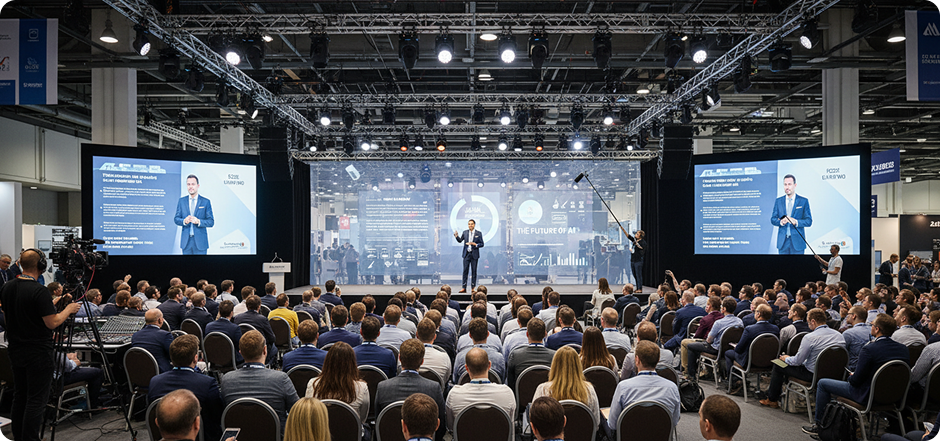
Think about what actually happens at a conference or product launch. In a single day, your company has access to more content opportunities than most marketing teams generate in a quarter. Your CEO is on stage articulating your vision. Your CTO is explaining technical decisions to a room full of peers. Your product team is demonstrating your platform to qualified prospects. Your founder is having genuine, unscripted conversations with investors, partners, and customers.
Every one of those moments is a piece of content. A keynote becomes a 60-second highlight Reel. A panel discussion becomes three LinkedIn thought leadership clips. A product demo becomes a feature walkthrough video. A customer conversation becomes a testimonial. A backstage moment becomes an Instagram Story that humanises your brand.
And yet most scale-ups capture none of it — because no one planned for it. The marketing team was focused on the stand design, the sales team was focused on meetings, and content creation was treated as something that would happen organically. It never does.
In a single day, your company has access to more content opportunities than most marketing teams generate in a quarter.
The three reasons tech companies fail at event content
1. No content strategy before the event
The most common failure is the most preventable. The company attends the event with a vague intention to “capture some content” but no specific plan for what to film, who to interview, which formats to produce, or which platforms to publish on. Without a shot list, a content brief, and a publishing schedule agreed before the event, even the best camera operator is guessing.
A conference is a chaotic, fast-moving environment. If you are deciding what to film while the keynote is happening, you have already missed three other moments that would have made better content. The strategy must be locked before anyone arrives on site.
2. No dedicated content resource on the day
The second failure is assigning content capture to someone who has other responsibilities at the event. The marketing manager who is also running the stand. The founder who is also meeting investors. The sales lead who “has a good phone camera.” None of these people can produce consistent, high-quality content while doing their actual job at the event.
Event content requires a dedicated resource — whether that is an in-house content person whose only job on the day is filming and editing, or an external production partner who arrives with a crew and a brief. If content capture is someone’s second priority, the quality and quantity will reflect that.
3. No post-event content plan
The third failure is the most expensive. Even companies that manage to film decent footage at events often fail to do anything useful with it afterwards. The files sit on a hard drive. The editing gets deprioritised because the marketing team is already onto the next campaign. Three weeks later, the content is no longer timely, the momentum from the event has passed, and the footage never sees the light of day.
Post-event content has a shelf life — and it is shorter than most teams assume. The most valuable event content is published during the event or within 24 to 48 hours of it ending. After a week, the conversation has moved on. After a month, the content is archive material, not marketing material.

Post-event content has a shelf life — and it is shorter than most teams assume.
A practical framework for turning events into content engines
If you are reading this and recognising your own company, here is a practical, repeatable framework. It works for conferences, trade shows, product launches, demo days, and any event where your brand is present and your audience is paying attention.
Phase 1: Before the event — build the content brief
Two to four weeks before the event, create a one-page content brief that answers five questions:
- What are the three to five content moments we must capture? (Keynote, panel, product demo, customer meeting, team moment)
- What formats will we produce? (60-second Reels, 3-minute interview clips, Instagram Stories, LinkedIn carousel, long-form recap)
- Which platforms are we publishing on? (LinkedIn, Instagram, TikTok, YouTube)
- Who is our dedicated content person on the day?
- What is the publishing timeline? (Same-day social, 48-hour highlights, one-week recap)
This brief is the single most important document in the entire process. Without it, everything that follows is improvised. With it, your content person arrives at the event knowing exactly what to capture, when to capture it, and what it will become.
Phase 2: During the event — capture with purpose
On the day, your dedicated content person works from the brief. They are not wandering the exhibition floor hoping for inspiration. They have a shot list, a schedule, and a clear set of deliverables to produce.
The highest-value content moments at any tech event, in order of priority, are typically:
- Keynote or stage moments — your CEO or CTO on stage is the most authoritative content your brand can produce. Film the full talk, then cut it into 60-second highlight clips.
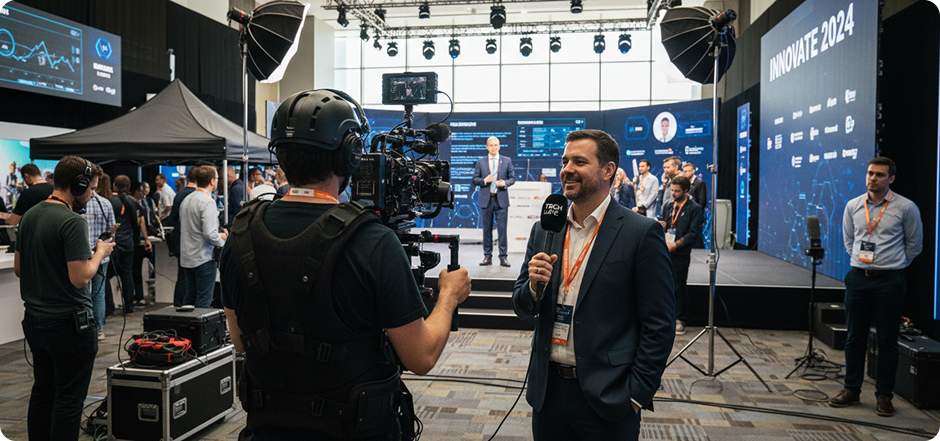
- Planned interviews — 90-second conversations with your team, customers, or partners. Pre-briefed, lightly scripted, filmed in a quiet corner with a lapel mic.
- Product demonstrations — your platform being shown to real users in real time. The most effective product marketing footage you will ever produce.
- Behind-the-scenes moments — the team setting up, the energy before going on stage, the first customer arriving at the stand. This content humanises the brand and performs exceptionally well on Instagram and TikTok.
The critical principle: edit and publish during the event, not after it. Your Reel from the morning keynote should be live on Instagram by lunchtime. Your LinkedIn carousel of product demo highlights should go out before the networking drinks. Speed is a genuine competitive advantage — while your competitors are filing away their footage for “the marketing team to sort out next week,” you are already in the feed.
Phase 3: After the event — extend the value
The event is over. For most companies, this is where the content dies. For a company with a plan, this is where the content starts its second life.
In the week following the event, produce and publish:
- A 2-to-3-minute event recap video — the highlight reel that captures the energy, the key moments, and the brand presence. Publish on LinkedIn and YouTube.
- Individual interview clips — each interview cut to 60 to 90 seconds and published as standalone LinkedIn and Instagram posts over the following two weeks.
- A “what we learned” thought leadership post — written by the CEO or CTO, reflecting on the key themes from the event. This performs exceptionally well on LinkedIn because it offers genuine insight, not just attendance.
- A thank-you or follow-up post — tagging the people you met, the companies you spoke with, and the conversations that mattered. This extends the networking value of the event into the digital space.
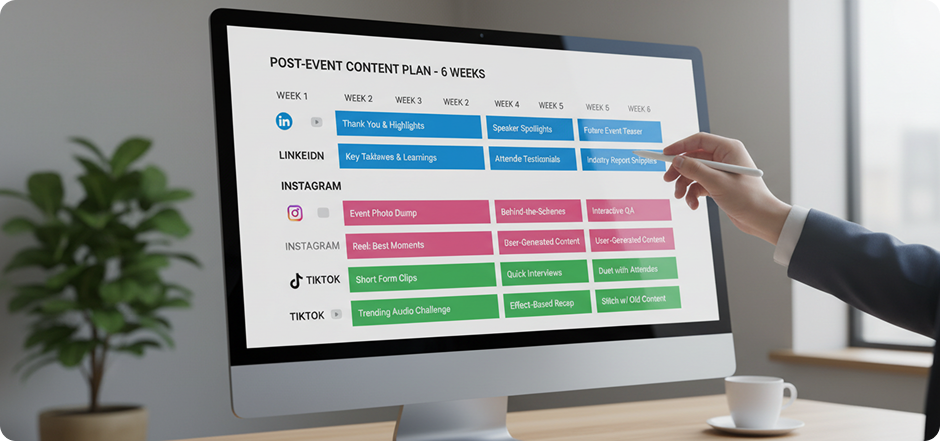
A single well-planned conference can generate four to six weeks of content across three platforms. That is not an aspiration — it is a realistic output if the brief is locked, the content person is dedicated, and the post-event plan is followed.
What this looks like in numbers
Here is what a well-executed event content strategy typically produces from a single two-day conference:
- 8 to 12 short-form video clips (Reels, Shorts, TikToks) — published during and after the event
- 3 to 5 interview clips — each featuring a team member, customer, or partner
- 1 event recap video (2 to 3 minutes)
- 10 to 15 Instagram Stories — published live during the event
- 2 to 3 written LinkedIn posts (thought leadership, recap, follow-up)
- 4 to 6 weeks of scheduled post-event content across three platforms
Compare that to the typical output — two LinkedIn posts and a group photo — and the gap becomes absurd. The event cost the same either way. The only difference is whether someone planned for the content.
A single well-planned conference can generate four to six weeks of content across three platforms.
The ROI conversation
The reason event content strategy matters commercially is straightforward: events are expensive. Conference sponsorships, exhibition stands, travel, accommodation, and team time represent a significant investment for any scale-up — often five figures per event. The marketing team that can demonstrate measurable digital ROI from that investment is the marketing team that gets the budget approved next year.
Event content is the bridge between event spend and digital performance. It turns a two-day physical presence into a six-week digital campaign. It extends your reach from the people who were in the room to the thousands of professionals in your sector who were not. And it creates a library of reusable assets — interview clips, product demos, thought leadership — that continue to work long after the event is forgotten.
Without it, your event investment generates conversations and business cards. With it, your event investment generates conversations, business cards, and a content library that compounds in value over time.
Conclusion
The next time your company attends a conference, a product launch, or a demo day, ask yourself one question before you book the stand: who is responsible for the content?
If the answer is “we will figure it out on the day” or “the marketing team will grab some photos,” you already know how this ends. You have seen it before.
If the answer is “we have a content brief, a dedicated content person, a shot list, and a six-week publishing plan” — then you are about to get more value from a single event than most scale-ups get from a year of social media.
The event is the easy part. The content is where the value lives. Plan for it.